

MEDEK accreditation
The Banking and Insurance associate degree program of the Vocational School has been accredited by the Association for Vocational Education Evaluation and Accreditation (MEDEK). Accreditation status, program outcomes, evaluation criteria and documents are available on the MEDEK subpages.
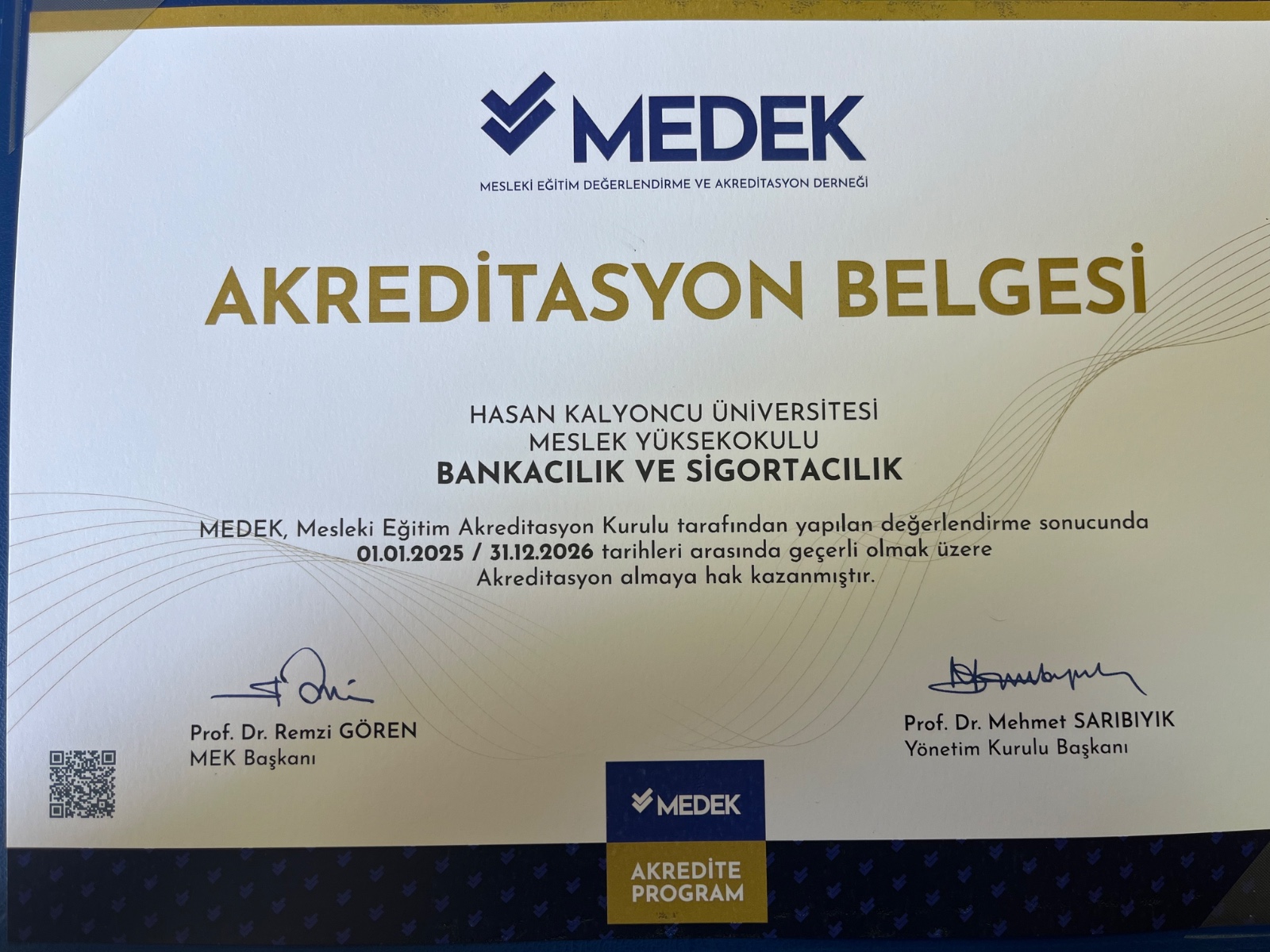
Accreditation Status
MEDEK Accreditation
Hasan Kalyoncu University Vocational School, Banking and Insurance Program (associate degree)
Accreditation period: 01.01.2025 – 31.12.2026 (conditional)
Accrediting Body
Association for Vocational Education Evaluation and Accreditation (MEDEK) is a non-governmental organization that evaluates and accredits associate degree programs.
MEDEK accreditation applies only to the Banking and Insurance associate degree program; the school’s other programs are not covered by this accreditation. Date and status information is provided in the accreditation certificate and at kalite.hku.edu.tr, where the accredited programs are listed. For program-based verification, see the MEDEK accreditation search page.
What is MEDEK?
What is MEDEK?
MEDEK stands for the Association for Vocational Education Evaluation and Accreditation. It is a non-governmental organization authorized by the Higher Education Quality Board (YÖKAK) to accredit Vocational School programs, in order to evaluate their conformity with defined standards, quality criteria and performance indicators.
MEDEK’s Objective
To pioneer the training of vocational personnel who follow professional developments, can respond to changing workforce needs, have high professional skills and equipment, are innovative and socially responsible, can take initiative, and possess the qualifications sought by the relevant sector.
MEDEK’s Mission
To contribute to raising the quality of education and teaching by providing information, external evaluation and accreditation services for associate degree programs
MEDEK’s Vision
To be a leading organization that defines the teaching and research activities and administrative processes of associate degree programs, as well as the quality of intermediate-level workforce, against national and international standards, and that grants quality registration by sharing the results with relevant institutions and organizations.
Accreditation Decisions and Validity Period
A program is accredited for a specific period of one (1) to four (4) years. The accreditation decision can be: Full Accreditation, Conditional Accreditation or Accreditation Candidacy.
Full Accreditation: a program is granted four (4) years of full accreditation when it meets all the minimum conditions specified in the MEK criteria (MEK is the sub-body of MEDEK: Vocational Education Accreditation Board).
Conditional Accreditation: If no criterion has been rated “1: Missing” in the overall evaluation of a program, but one or more criteria have been rated at least “2: Insufficient”, accreditation is granted for only two (2) years. In the second year of accreditation, the Vocational School may apply for re-accreditation according to the timetable set by MEK. A program cannot be granted conditional accreditation for more than two consecutive periods. For programs granted two-year conditional accreditation, an on-site interim evaluation is conducted in the final year (second year) of the accreditation validity period. The interim evaluation focuses on the criteria rated “2: Insufficient” and “3: Acceptable” in the overall evaluation. If no improvement is identified in these criteria during the interim evaluation, the accreditation of the program is not extended. This decision is open to appeal. On the other hand, if the on-site interim evaluation results in scores of “3: Acceptable” or higher, the Accreditation Period is extended by 2 more years.
Accreditation Candidacy: If no criterion has been rated “1: Missing” in the overall evaluation of a program, but none of the criteria has been scored “(4)” or “(5)”, and the shortfalls are expected to be completed within one year, a one-year “Accreditation Candidacy” status is granted. If, after the site-based evaluation in the following year, the criteria rated “2” rise to “3” or above, the Accreditation Period is extended by 3 more years. If some criteria continue to receive a “2”, a “Conditional Accreditation” decision is made.
Accreditation Decisions Summary Table
| Accreditation Decision | Full Accreditation | Conditional Accreditation | Accreditation Candidacy |
|---|---|---|---|
| Total Accreditation Period | 4 Years | 2 Years + (Interim Evaluation) 2 Years = 4 Years | 1 Year + (Interim Evaluation) 2 or 3 Years = 3 or 4 Years |
| Minimum Conditions for an Accreditation Decision | Scoring for all criteria may be at least 3, 4 or 5. | In the overall evaluation of a program, if no criterion has been rated “(1)” but criteria have been rated 2 in addition to 3, 4 and 5, this decision is made. | In the overall evaluation of a program, if no criterion has been rated “(1)” but none of the criteria has been scored “4” or “5”, this decision is made. In other words, if all criteria have been rated 2 or 3. |
| Interim Evaluation | At the end of the second year, an interim evaluation report focused on the criteria rated “2” and “3” is submitted. A team consisting of a chair, at least two evaluators and one student evaluator conducts a site visit. | At the end of the first year, an interim report prepared for the criteria rated “2” and “3” is submitted. A team consisting of a chair, at least two evaluators and one student evaluator conducts a site visit. | |
| Next Accreditation Process | At the end of the third year, an application for re-accreditation is made. | If criteria rated “2” rise to “3” or above, the accreditation period is extended by 2 years. If criteria rated “2” still exist, a second “Conditional Accreditation” decision is made. | If criteria rated “2” rise to “3” or above, the accreditation period is extended by 3 years. If some criteria continue to receive “2”, a “Conditional Accreditation” decision is made. |
Benefits for TYÇ-AYÇ and Associate Degree Students
Quality standards of accredited MYO programs will improve, teaching and learning processes will be enhanced, learning outcomes will become more consistent across MYOs, the reliability of competencies will be ensured, and recognition processes between institutions will be facilitated. In addition, it will become possible to use the TYÇ logo on diplomas through alignment with the Turkish Qualifications Framework (TYÇ) and the European Qualifications Framework (AYÇ). Thanks to the TYÇ – AYÇ alignment of accredited programs, diplomas will be recognized internationally, and national and international horizontal and vertical mobility will develop positively. In this way, employers will reach better-qualified human resources, and MYO students will find employment more easily.
MEDEK Pages
Banking and InsuranceIntroduction, curriculum and academic staff of the program.